History of the DeTour Reef Lighthouse
Overview
Since 1847, a lighthouse has been located at DeTour Passage at the northwestern head of Lake Huron at the mouth of St. Mary’s River, which connects Lake Huron to Lake Superior.
The first lighthouse, the DeTour Point Light Station, was established on April 13, 1847, with the land being acquired by presidential set aside. The buildings were constructed in the same year. However, the light was not shown until 1848. Apparently by the time the construction was completed it was too late in the year to fit the light and employ the keeper. The original structure was described as a white stone tower approximately 65 feet high with a five room, one and a half story house. There are no known photographs or drawings of the original structures. The iron tower (pictured here) that most people are familiar with at the site was constructed in 1861.
Due to ever increasing ship traffic and the dangerous offshore reef, a new lighthouse was built offshore called the DeTour Reef Light.
Construction of the DeTour Reef Lighthouse
The DeTour Reef Light, located a mile offshore from the original onshore lighthouse, was built in 1931. It is well known to ship captains and pleasure boaters who sail the upper Great Lakes. The lighthouse stands as a testament to the importance of shipping in the region's political, economic and social history.
The lighthouse foundation, resting in 23 feet of water, is a crib style concrete 20-feet high 60-feet square base that supports the reinforced concrete/steel Art Deco-style square building. The white structure with a red roof has a tower extending 63 feet over the deck making the top of the tower 83 feet above the water.
Beginning in the 1870's, crib foundation construction was used extensively for lighthouses on the Great Lakes. The DeTour Reef Light is one of these examples. Wooden cribs were constructed ashore, and then towed to the site and filled with stone.
Once the crib had settled to the bottom, it was capped with concrete or some other masonry. Often once the crib had settled, it was necessary to level the structure by adding weight to one side or another. When construction on the building was completed, the focal plane of the lens stood 74 above the water. The light was first lit on November 7, 1931.
For generations the light at DeTour Passage has provided a beacon for those vessels seeking the "Gateway to Superior."
Lens
The original illuminating apparatus in the 1848 light was a fixed white light produced by 13 Argand lamps each with a 14" reflector. The light was designed with a 270-degree arc in attempt to not waste fuel oil 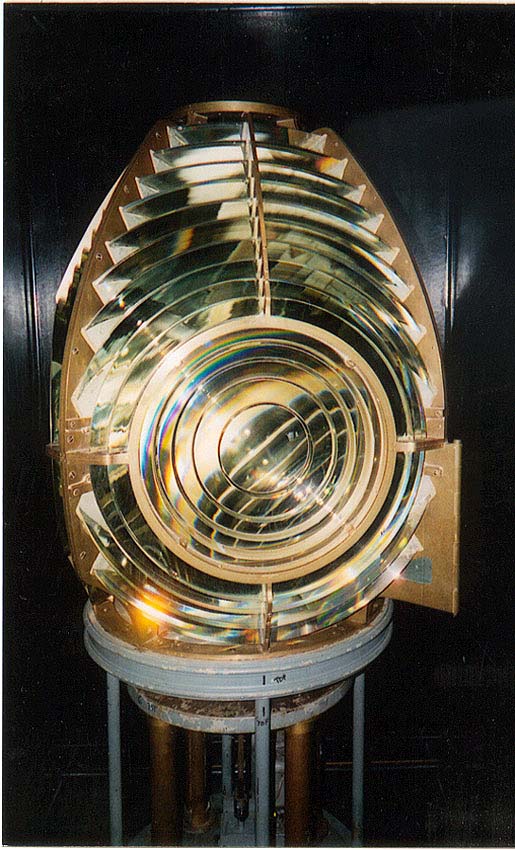 in lighting the peninsula to the north. The original apparatus was replaced in 1857 by a 4th order Freeness lens producing a fixed white light. A Fresnel lens is a type of optic consisting of a convex lens and many prisms of glass, which focus and intensify the light through reflection and refraction. The 4th order lens was replaced in 1870 by a fixed, white, 3rd order lens. At the same time, the remnants of the original stone tower that was still standing on the site were removed. In 1907, the 3rd order lens was replaced by a 3-1/2-order bi-valve lens. This lens did not last long. It was replaced in 1908 by the last Fresnel lens used at the DeTour Point Light which was a 3-1/2 order flashing white light. This light had a characteristic of a one-second flash and a nine-second eclipse and could be seen from 30 miles away. The lens was manufactured in Paris, by the Barbier, Benard & Turenne Co. It has the number USLHE 317 stamped on it. This same lens was relocated to the new DeTour Reef Light structure in 1931. The light remained white until the 1936 season when the color changed from straight white to white with a red sector that faced land. This was affected through the use of a color screen or shade inside the lens room. This magnificent lens was dismantled in 1978 and is now on display at the DeTour Passage Historical Museum in DeTour Village, Michigan. in lighting the peninsula to the north. The original apparatus was replaced in 1857 by a 4th order Freeness lens producing a fixed white light. A Fresnel lens is a type of optic consisting of a convex lens and many prisms of glass, which focus and intensify the light through reflection and refraction. The 4th order lens was replaced in 1870 by a fixed, white, 3rd order lens. At the same time, the remnants of the original stone tower that was still standing on the site were removed. In 1907, the 3rd order lens was replaced by a 3-1/2-order bi-valve lens. This lens did not last long. It was replaced in 1908 by the last Fresnel lens used at the DeTour Point Light which was a 3-1/2 order flashing white light. This light had a characteristic of a one-second flash and a nine-second eclipse and could be seen from 30 miles away. The lens was manufactured in Paris, by the Barbier, Benard & Turenne Co. It has the number USLHE 317 stamped on it. This same lens was relocated to the new DeTour Reef Light structure in 1931. The light remained white until the 1936 season when the color changed from straight white to white with a red sector that faced land. This was affected through the use of a color screen or shade inside the lens room. This magnificent lens was dismantled in 1978 and is now on display at the DeTour Passage Historical Museum in DeTour Village, Michigan.
Lighthouse Foghorn
In March of 1998, DeTour Reef Light Preservation Society member Jeff Laser of
Bellville, Ohio, discovered the foghorn from the light sitting on a pallet at a
warehouse belonging to the Great Lakes Historical Society in Vermilion, Ohio.
The DeTour Reef Light Preservation Society contacted them and they agreed to
return the foghorn to its original home. The horn is a 475-pound Diaphone air
type unit. The returned horn has been restored by Jeff and is now on display at
the Drummond Island Historical Museum.
Lighthouse Today
Today, after years of service, the DeTour Reef Light may appear in good condition from a passing boat or shoreline glimpse, but it needs a long term project to restore it properly.
Additional Information
Want more information about the DeTour Reef Lighthouse's history? Email for more information.
|